Thursday, September 29, 2011

Sooty Blotch and Flyspeck of Apples

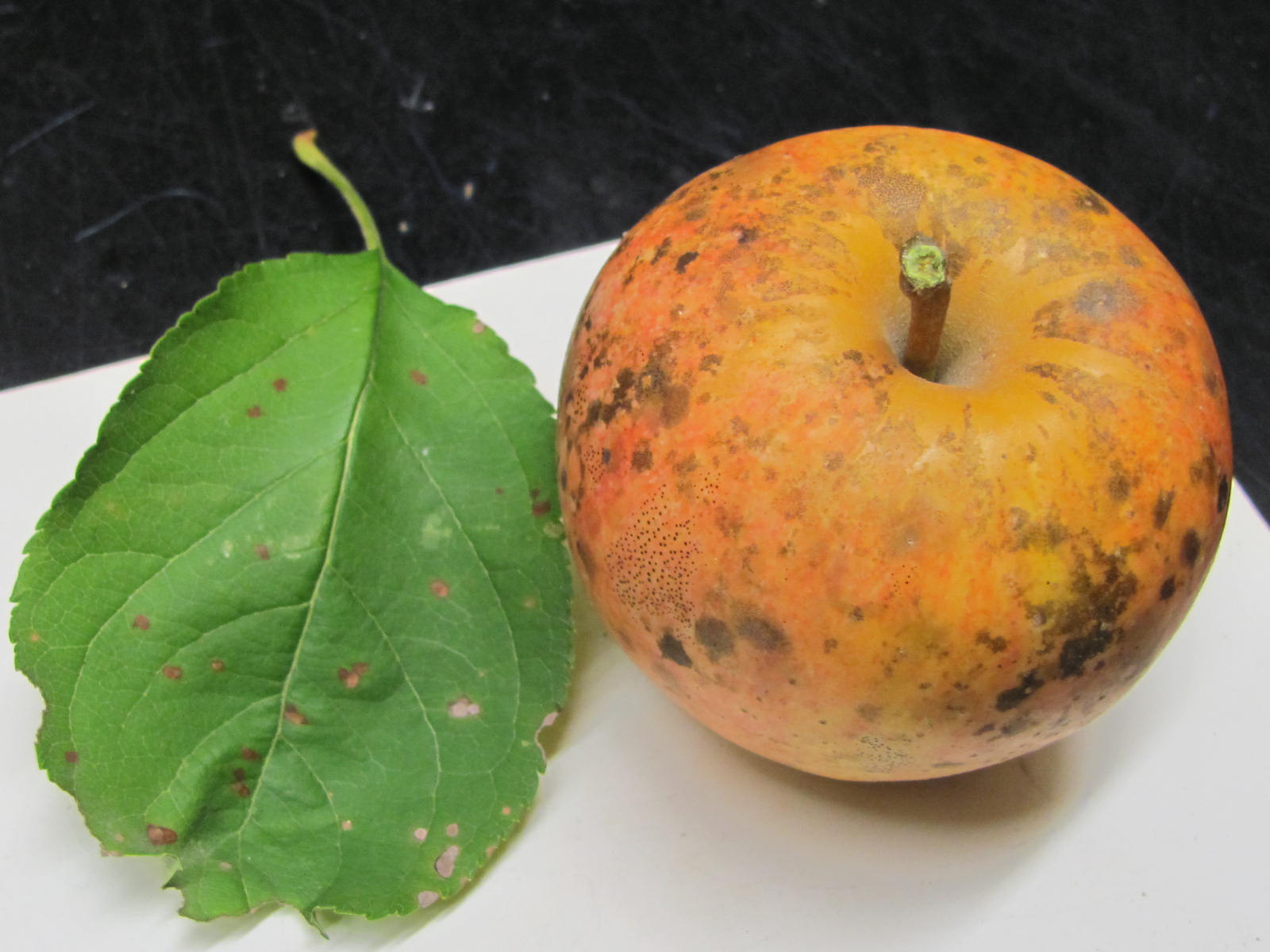
Sooty Blotch and Flyspeck (Photo: Bugwood)
With fall coming fast, it’s time to gear up for apple season. Before you make your trip to the local farmer’s market, we decided to introduce you to the two most common apple diseases in North Carolina, sooty blotch and flyspeck. Without the use of fungicides, these two diseases would affect virtually all apples grown in the southeastern United States. These diseases are found on all cultivars of apples and both diseases can be found on the same apple at the same time.

The most common symptom associated with sooty blotch is the growth of feathery, olive green fungal colonies on the surface of mature fruit. Flyspeck can be recognized by the presence of very small, shiny, black, dots arranged in an irregular or circular pattern on the fruit surface. This gives fruit the unappetizing appearance of being covered with fly droppings.

Sooty Blotch and Flyspeck  (Photo: Bugwood)  
Both of these diseases cause only superficial damage on the apple surface. The fungi that cause them, grow on the surface of the cuticle and do not damage the apple itself or affect its flavor or quality. Sooty blotch and flyspeck cause losses in commercial apple production because affected fruit are downgraded from valuable fresh market grades to much cheaper processing or juice grades.
Sooty Blotch and Flyspeck (Photo: PDIC Database)

Over 60 putative species of fungi have been associated with sooty blotch and flyspeck worldwide. In the Southeast, Peltaster fructicola, Leptodontidum elaitus, Stomiopeltis spp. and Geastrumia polystigmatis are the most common species associated with sooty blotch and Schizothyrium pomi is the most common species associated with flyspeck. Fungi that cause sooty blotch survive the winter on apple twigs and reservoir hosts surrounding the orchard. Spores are dispersed by wind and windblown rainwater to developing fruit in the spring and early summer. Secondary spread occurs throughout the summer. Usually, symptoms can be seen 20 to 25 days after infection.


S. pomi also overwinters on apple twigs and other perennial reservoir hosts. Airborne ascospores are the primary means of infection and are usually produced for about 2 months beginning around bloom. Specks, which are actually fruiting bodies of the fungus, appear about 3 to 6 weeks after infection. Secondary spread occurs through windblown conidia produced on infected fruit and twigs and on reservoir hosts surrounding the orchard.

Sooty Blotch (Photo: PDIC Database)
Commercial growers control these diseases with cultural practices and fungicide applications. Cultural control practices include pruning during dormant and summer seasons and fruit thinning. Pruning and fruit thinning reduce the drying time within the canopy and allow better fungicide penetration through the canopy. Sooty blotch and flyspeck fungi require wetness to infect. Pruning and fruit thinning discourages these fungi by increasing airflow through the canopy. Mowing weeds and grasses under apple trees also helps trees stay dry. Another important cultural practice is removal of surrounding reservoir hosts, especially brambles. Surrounding blackberry plants act as harbors where these fungi are able to multiply during the season and then spread to nearby apple fruit.

In addition to cultural practices, these diseases are controlled with preventative fungicide applications. Preventative sprays need to be applied beginning about second cover (about a month after bloom) and continuing at 10 – 14- day intervals until harvest.


Since sooty blotch and flyspeck are harmless to people and apples, there is no reason to apply fungicides to control them at home – nor do you need to avoid buying apples with sooty blotch and flyspeck, especially for cooking or baking. Most of the fungal colonies can be removed by washing the apples in a mild solution of bleach.


For more information:
Apple Disease Factsheet


Special thanks to Dr. Turner Sutton for helping with this post!

Tuesday, September 20, 2011

Sooty Mold: Ugly... but Mostly Harmless

Have you ever noticed that some of your shrubs have a black mold coating their leaves? Recently, I was at home visiting my parents and my mom was telling me that her crape myrtle was covered in some sort of black mold.  She was very concerned and wanted me to go “check it out.”  I took one look at the bush and knew we were dealing with sooty mold.  
Sooty Mold on Crape Myrtle (Photo By: B. Lookabaugh)
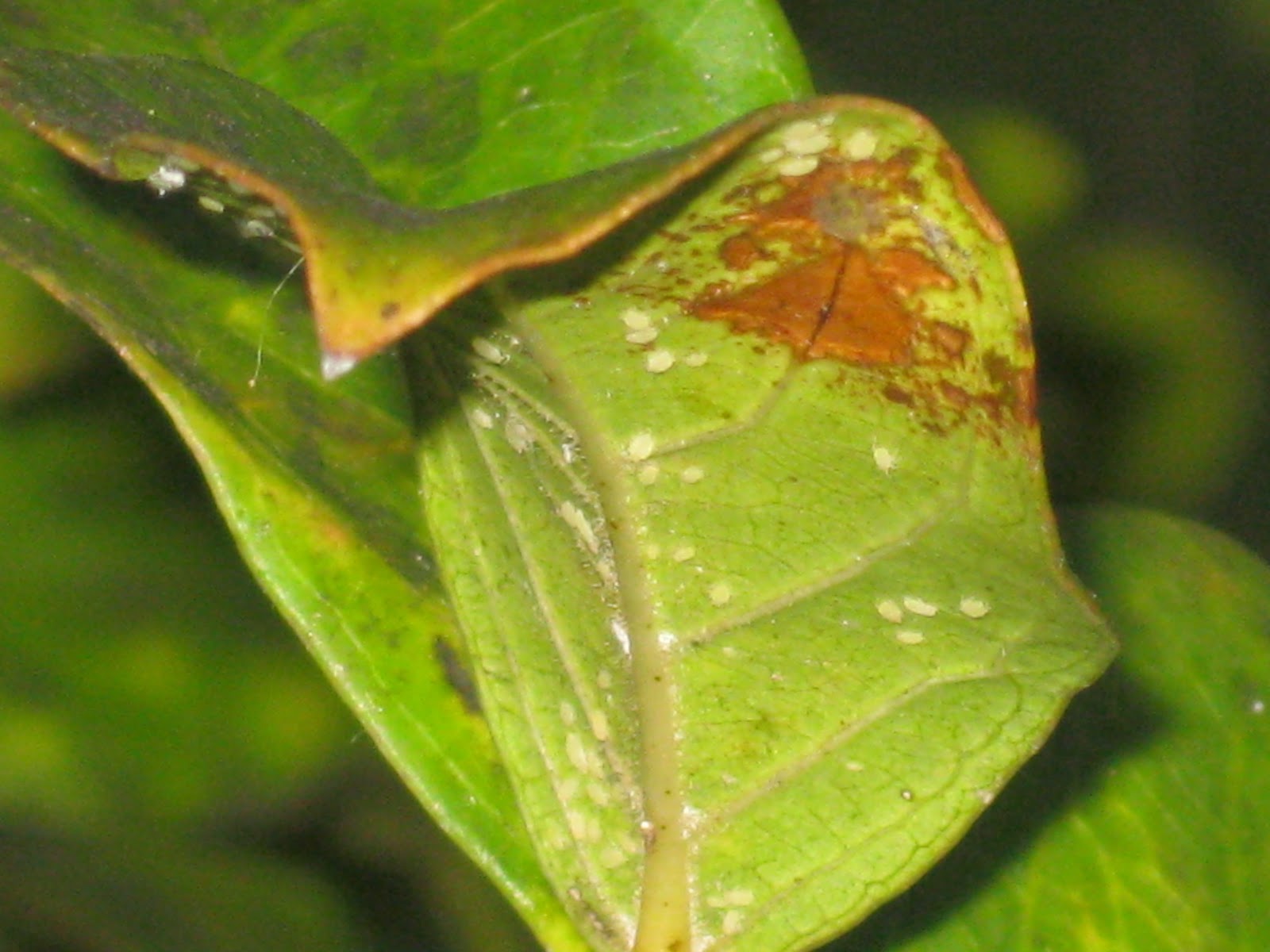
Sooty molds are dark-colored, nonparasitic fungi that grow on insect honeydew.  So what is honeydew - sounds tasty doesn’t it? It is a sweet, sticky liquid produced by aphids, soft scales, mealy bugs, and some species of leaf hoppers.  These insects suck sugary sap from the leaves and excrete honeydew - a mixture of sugars, amino acids, and other organic substances.  Essentially, honeydew is aphid poop!

Soon after a plant is heavily infested with aphids or other sucking insects, leaves are covered in honeydew. The honeydew serves as a nutritional substrate for dark-walled sooty mold fungi. In severe cases, honeydew can drip from infested leaves and stick onto other plants or objects.  When this happens, you might end up with sooty mold on your car, house, propane tank, or patio furniture!
Sooty mold growing on sign beneath infested tree
(Photo By: Whitney Cranshaw, Bugwood)
Like my parents, you may notice more sooty mold problems after it rains. Rain can deposit honeydew even on plants that are not infested with honeydew-producing insects. Since spores of sooty mold fungi are also dispersed in wind and rain, sooty mold problems soon follow.

Sooty molds typically grow in patches on plant surfaces and can be distinguished from other fungi because they are strictly superficial.  The dark mycelium can be wiped clean from the plant surface using a moistened paper towel or your hand. Most sooty mold fungi are harmless to plants. If the mold is extremely abundant, it can prevent leaves from obtaining adequate sunlight and thus reduce plant vigor.  Sooty molds also lessen the aesthetic value of ornamental plants and shrubs. 

Even if sooty mold is extensive, it is best not to apply fungicides.  The mold can be washed away with a forceful jet of water.  You can control the insects that produce the honeydew on which the sooty mold grows with insecticidal soap or horticultural oils.  Horticultural oils also loosen the sooty molds from the plant surface, which speeds up the weathering away process. 
Aphids: Responsible for producing honeydew
(Photo By: B. Lookabaugh
Some plant species and varieties are more prone to aphid problems and thus sooty molds than others. For example, some varieties of crape myrtle are not prone to aphid and sooty mold problems whereas others are very likely to be infested.  See Crape Myrtle Diseases & Insect Pests from Clemson University for more information about sooty molds and a list of recommended varieties.  


For more information:

Friday, September 16, 2011

Rainy Day Weekend Activities

Need something exciting to do this weekend? Join the Plant Disease and Insect Clinic at BugFest and CALS Annual Tailgate.  BugFest is an annual festival that celebrates all things creepy and crawly! This year, the theme is spiders! The festival is held at the North Carolina Museum of Science in downtown Raleigh.  NCSU Department of Plant Pathology (with the Plant Pathology Society of North Carolina and USDA) will once again be featuring the BugBus exhibit.  Grad students will be showcasing mites as plant pests and carriers of plant pathogens.  Kids can come learn about spider mites, fig mosaic virus, rose rosette virus, nematodes, and mummy berry disease.  We will have microscopes set up so kids can view these tiny mites in action. BugFest hours are from 9am to 7pm on Saturday, September 17th.  There are plenty on indoor exhibits, along with lots of spidery themed things to do outside! 

For more information on BugFest, click here.

In addition to BugFest, the Department of Plant Pathology will also be at CALS Tailgate.  CALS Tailgate is an annual event for NC State Alumi.  In addition to a great meal, attendees will get the opportunity to see what our College has to offer from academics, research and extension.  The event is packed around fun events, like a silent auction, live band, departmental displays, children's games, and of course, lots of free stuff.   The Department of Plant Pathology will have a display featuring the Plant Disease and Insect Clinic, Plant Propagation Unit, and Turfgrass Diagnostics.  Head over to our booth to see what our department has been up to and learn about plant diseases. 

After the tailgate, you can head over to watch the NCSU vs. South Alabama game for Military Appreciation Night.  Mark Gottfried, the new men's basketball coach, will be showing his appreciation for our military by parachuting into the stadium!

For more information on CALS Tailgate, click here

Hopefully the cool rainy weather won't ruin your weekend! We hope to see you Saturday!
 

Tuesday, September 13, 2011

Lions, Tigers, and ORB SPIDERS, OH MY!

With BugFest coming this weekend to Raleigh's Museum of Natural Sciences, we found it appropriate to have a short posting on spiders, specifically orb spiders.  For those of you not familiar with BugFest, it is an annual festival that celebrates all things creepy and crawly! Each year, the festival has a different theme, with this year's theme being SPIDERS.  David Stephan, the Plant Disease and Insect Clinic's resident entomologist, prepared the following post on orb spiders, a common group of spiders found throughout North Carolina.  

Orb Spiders

Spiders are among the most maligned and misunderstood creatures on Earth.  These fascinating arthropods are mostly beneficial to humans as predators of insects and other pests, but the few that are genuinely dangerous to us have given all spiders a bad rap.  Almost all spiders are venomous (except for the species in one obscure family), and almost all are predators.  Very few species are truly aggressive, most opting to freeze or flee in encounters with people.  All spiders produce silk, and many of them use this silk in various ways for prey capture, construction of retreats, courtship, protection of their eggs, etc.

Orb spiders of the family Araneidae are among our largest and most beautiful spiders (oh yes they are!).  They spin those large, radially symmetrical webs that people often find in their yards from mid summer into fall.  Outdoor lights and windows attract many insects, which makes them popular sites for orb spiders and others to spin their webs.  The spider may wait in the center of its web, or in a hidden retreat nearby, ready to rush out and wrap prey that fly into the web.  Most adults will die by winter, after preparing 1 or more sturdy egg cocoons.  Orb spiders are timid and avoid contact with people, but blundering into one of their webs in the dark could give you a heart attack.

Golden Silk Orb Spider, Nephila clavipes
(Photoby David Hillquitst, Bogue Banks, NC)

Our largest NC orb spiders belong to the genera Araneus, Argiope, Neoscona and Nephila.  The mostly tropical species of Nephila include the world’s largest orb spiders, and can build spectacular webs.  The silk that spiders produce has amazing properties of tensile strength and extensibility, and scientists have been studying it for many years.  Researchers in the College of Textiles here at NCSU have worked with orb spiders in the past.  Currently, researchers in our Dept. of Chemical & Biomolecular Engineering are using the latest technology to study, duplicate and even improve on some of those properties of spider silk. 

Golden Silk Orb Spider, Nephila clavipes
(Photoby David Hillquitst, Bogue Banks, NC)

Not enough spider info to satisfy your appetite? Be sure to visit BugFest, Saturday September 17th.  NCSU Departments of Plant Pathology and Entomology have displays with even more info about spiders!

Additional Links:

Special thanks to David Stephan for contributing this post!

Wednesday, August 31, 2011

Peanut Disease Control Following Hurricane Irene

Written by: Dr. Barbara Shew, Peanut Extension Specialist

Sclerotinia blight
Heavy rain from Irene, wet vines, and the recent cool nights make ideal conditions for Sclerotinia blight. Today (Aug 31), all reporting weather stations in North Carolina are advising sprays and indicating high to very risk of Sclerotinia blight. Conditions will remain highly favorable for Sclerotinia blight for at least the next 5-7 days.
Make sure that fields with a history of Sclerotinia blight are protected. The last effective spray date for today is August 10. This accounts for 3 weeks of protection following a fungicide application. Fields that have not been sprayed since August 10 are not protected.  

It is very important to catch Sclerotinia outbreaks when they first occur – this is the time when fungicides are most effective at controlling the disease.  Scout carefully if you are in doubt about your field history or control efforts to date. 

Even in fairly advanced cases, Sclerotinia blight can be hard to see unless you check plants thoroughly.  Scout by checking 50 feet of row in several locations across a field.  Part the rows and check inside the canopy for the fluffy growth of the Sclerotinia blight fungus on stems, leaves, and pegs. Infections may be present on leaves and stems that are not touching the ground, particularly after a heavy rain. Other signs and symptoms include bleached and shredded stems and black fungus structures (sclerotia) that look like mouse or insect droppings. Sclerotia often are found on or inside stems and pods.
Early development of Sclerotinia on stem
Stem shredding by Sclerotinia (Photo by Bridget Lassiter)

We are currently are working on yield loss models for Sclerotinia blight. While we have not finished our analysis, we have a rough idea of what to expect.  Assuming a Sclerotinia-free yield of 4,600 lb/a, yield decreases about 50 lb/a for every 1% incidence (plants diseased) of Sclerotinia blight at 110 days after planting. This suggests that a reasonable treatment threshold at this point in the season is between 2-3% of plants diseased. If you expect a delayed harvest, I would definitely lean to the low end of this range (or even lower) so that you can maintain good control through the next several weeks. 

Leaf spots and web blotch
Late leaf spot thrives when leaves are wet and night temperatures drop a bit. Late leaf spot is more difficult to control than early leaf spot. It will be very important to stay on top of late leaf spot control for the next couple of weeks - or longer if you expect a delayed harvest.  Be particularly watchful on highly susceptible cultivars like Gregory and Perry.

We have seen little to no web blotch in the past several years, but outbreaks sometimes follow a tropical storm. Web blotch is recognized as large (½-inch) dark patches or blotches with faint or irregular margins. They are found only on the upper surface of the leaf at first. Young lesions have a grayish cast but later the blotches turn light brown.  NC-V11 and VA 98R are highly susceptible to web blotch and most prone to outbreaks. A good leaf spot control program usually will control web blotch.
Web blotch

Headline will give excellent protection against late leaf spot and web blotch at 9 -12 oz/a. Most other foliar fungicides also perform well against these diseases. Avoid using tebuconazole since it is very weak against late leaf spot. Use a multi-site fungicide such as Bravo (chlorothalonil) for the last spray of the season. This will help to reduce the risk of developing pathogen populations that are resistant to other fungicides. 

Rust
Peanut rust is rare in North Carolina, but sometimes shows up after a storm. Peanut rust is NOT the same rust that infects soybeans, but in some ways it is similar. Like soybean rust, peanut rust does not survive our winters. It is a sporadic problem in the southern-most peanut production areas of the US and is common in Central American and Caribbean countries. As with soybean rust, spores of peanut rust can be transported over long distances by hurricanes and other storms. Considering the path that Hurricane Irene took, it is possible that we will see scattered outbreaks of peanut rust.
Rust

Peanut rust produces numerous small reddish-brown pustules on the undersurface of the leaf. The pustules erupt to release millions of rust-red spores. These spores will stain a white cloth or paper that is swiped on the underside of a rusted leaf.  Rust epidemics start in hot spots and spread quickly. Fungicides that are effective against rust include Bravo, Abound, and tebuconazole. Tilt (propiconazole) is not effective.

Friday, August 26, 2011

Corn Smut: Friend or Foe?

Written by: Dr. Barbara Shew and Emma Lookabaugh

Sweet corn at the local farmers market
(Photo by: H.D. Shew)

On summer days, farmer’s markets are bursting with sweet corn. Shoppers buy ears by the dozens for good eating now and to stock their freezers for the winter. Corn – both field and sweet – is a relatively healthy crop and diseases usually do not trouble the home gardener. An exception is corn smut – it’s both common and easily recognized by its grotesque tumor-like galls and masses of dark sooty spores.   
Recently, Dr. Mike Benson, a professor in our Department, brought in some smutted ears of sweet corn for class.  The infected super sweet corn was his second planting during the first week of June.  He noted that the fungus didn’t start showing up until the ears starting filling in during the first week of August and estimated that about 15% of his plants were infected in mid-August. 

The corn smut fungus, Ustilago maydis, attacks corn (or maize; Zea mays) and its wild relatives (Zea spp.).  It can infect all actively growing corn tissues, but the most obvious symptoms are tumor-like galls on the ears.  Young galls are white and firm and are covered with a semi-glossy periderm, which eventually ruptures, exposing masses of sooty teliospores.  
Young corn smut galls
(Photo: H.D. Shew)
The teliospores serve as overwintering inoculum for future corn crops.  In the spring, teliospores are windblown or rain-splashed to nearby corn plants. The teliospores germinate to form sexual spores called basidiospores or sporidia.  The sporidia can also be dispersed in wind or rain. Later, two sporidia fuse and give rise to the infective stage of the fungus.  

Any above-ground plant part can be infected, including ears, tassels, silks, stalks, nodal shoots and leaf midribs. Distorted tissue may be noticeable within days after infection. Typically, galls form within a week and continue enlarging for up to three additional weeks.  Initially, galls are composed primarily of host tissue undergoing tumor-like growth. As the galls age, their fleshy interior becomes streaked with black as dark sooty teliospores begin to replace the white host tissue. Eventually the gall becomes a mass of spores, dehydrates, and ruptures, releasing the teliospores.  
Mature corn smut galls
(Photo: H.D. Shew)
Individual developing kernels are infected through the silks. Kernels are not susceptible to infection once pollination occurs, so any condition that reduces pollination favors smut infections. Drought stress (when pollen dies or tassels stop producing pollen) or extremely wet, humid weather (causing poor or no pollen production) opens up the window for infection.  University of Illinois Professor Emeritus Jerald Pataky says that “wimpy males,” that is, plants that don’t produce pollen in adverse conditions or males (tassels) that are not ready when the females (ears) are ready for pollination, are more susceptible to smut.  
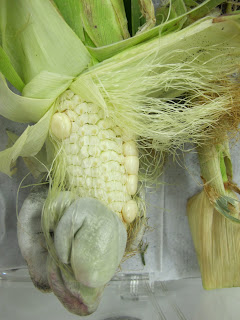
Gall on single kernel
(Photo: H.D. Shew)
Smut usually makes sweet corn unmarketable due to cosmetic damage, but in parts of Mexico, it is actually prized. Traditional farmers gather young galls after natural infection and market them as Cuitlacoche (or Huitlacoche), a delicacy in Mexican cuisine.  Often called the “Mexican truffle” or a “food of the gods,” it has been served up in Mexico since Aztec times.  Nowadays, there is great interest in developing techniques for inoculating ears with smut and marketing the galls as gourmet fungi to upscale restaurants. It is a favorite ingredient in many soups, appetizers, and entrees because of its unique combination of earthy and corn flavors.  Even here in Raleigh, NC, you can order up cuitlacoche and get a taste of this traditional Mexican delicacy. 
Chicken breast stuffed with smut fungus
(Photo: B.B. Shew, Jibarra Restaurant)
In case you *don't* want smut in your corn, control options are limited. Rotation is somewhat helpful and it may help to remove and destroy (or eat!) smutted ears before the galls erupt.  “Resistant” varieties are commonly recommended for control, but performance can be erratic since most are not truly resistant but instead escape infection. Choose varieties that are known to perform well in your region. Make several plantings during the spring. If all goes well, this will keep you in a steady supply of sweet corn for the summer. This also increases the chances that some of your plantings will escape major problems with poor pollination and smut.  
Corn at the farmers market
(Photo: H.D.Shew)


References and links of interest:

Pataky, J. K., and K. M. Snetselaar. 2006. Common smut of corn. The Plant Health Instructor. DOI:10.1094/PHI-I-2006-0927-01

Jerald Pataky’s cuitlacoche recipes page http://www.sweetcorn.illinois.edu/Common-smut/Recipes.htm

In Mexico, Tar-Like Fungus Considered Delicacy

Jibarra Modern Mexican Restaurant, Raleigh, NC http://www.jibarra.net/

Mary Ann Hansen. Corn Smut. Virginia cooperative extension publication 450-706. http://pubs.ext.vt.edu/450/450-706/450-706.html

Special thanks to Dr. Pataky for help with this blog!

Wednesday, August 24, 2011

Armillaria Root Rot in the Landscape: Attack of the "Humongous Fungus"

Armillaria Fruiting Bodies (NCSU PP Slide Collection)
Root rot is one of the most commonly diagnosed disease problems of woody plants in landscapes in North Carolina.  
Each year we see dozens of shrubs and trees that have one of the “big three” root rotting diseases: Phytophthora root rot, Thielaviopsis black root rot, or Armillaria root rot.  

This post will feature Armillaria root rot.  Be on the lookout in the upcoming weeks for posts on Phytophthora root rot and
Thielaviopsis black root rot!

Armillaria root rot is caused by species of the fungus Armillaria.  Common names for this group of fungi include the oak fungi, shoestring root rot fungi, or the honey fungi, the latter referring to the honey-colored mushrooms the fungus produces.  

Armillaria is a common soil inhabitant and can infect a very wide host range including; oaks, maples, azaleas, beeches, birches, boxwoods, cedars, dogwoods, firs, poplars, rhododendrons, yews, roses, spruces, and sycamores (pretty much any woody tree or shrub).  It can be destructive in orchards or on fruit trees in the landscape. 
Symptoms of Armillaria Root Rot (NCSU PDIC) 

Armillaria is typically a problem in older plants or plants that have been stressed due to drought, frost, insect attack, mechanical injuries, poor drainage, low soil fertility excessive shade, or pollution damage.  However, it can be an aggressive pathogen under some conditions.  Severe infections of young plants in nurseries can result in a quick death.  Older or mature plants can withstand infections for several years, resulting in a slow decline, eventually ending with the death of the plant.  

Above-ground symptoms include leaf drop, dieback, and an overall decline in plant vigor.  On conifers, the crowns of infected plants start to thin and change colors, often turning red, brown, or yellowish. Conifer infections sometimes result in heavy resin flow at the tree base.  
Armillaria Symptoms on Juniper (NCSU PDIC)

Armillaria infections start in young roots, but soon the fungus begins to decay larger woody roots. In the early stages of infection, wood becomes slightly grey and can have a water-soaked appearance.  Later, the wood becomes light yellow to white and has a soft, spongy rot.  Often, rotted areas are offset by black lines of zonation.  
Note the black lines of zonation (Photo: Bugwood)

Severely diseased trees can pose significant safety hazards during storms since branches and bases are weakened and can easily break under windy conditions or if under added pressure from snow or ice.  
Windthrow Hazard (Photo: Bugwood)

Unlike most plant pathogenic fungi, Armillaria produces mushrooms and other structures that are visible to the naked eye. Three diagnostic signs of Armillaria root rot include:

1.  Mycelial Fans: The most common diagnostic sign of this disease can be found beneath the bark (between the bark and the wood) at the base of the tree or shrub.  White or creamy paper-like mycelial fans can be observed when the outer bark is carefully peeled away.   These white mycelial fans can also be found beneath the bark of infected roots and root collar area. 
White Mycelial Fans (Photo: Bugwood)
White Mycelium Under Bark (E. Lookabaugh)

2.  Black Rhizomorphs: Sometimes rhizomorphs (dense strings of mycelium) that look like black shoestrings can be found under the bark or throughout the soil around infected tissue.  Rhizomorphs serve as one of the primary means of dissemination.  Rhizomorphs grow through the soil from infected trees, roots, or old stumps.  They are able to directly penetrate healthy roots and cause disease. 
Shoestring-like Rhizomorphs (Photo: Bugwood)

3.  Honey Mushrooms:  In the fall, honey-colored mushrooms can be seen growing near the base of diseased trees and shrubs.  Typically, these mushrooms grow in clusters.  These mushroom produce microscopic basidiospores, but the spores are not thought to play an important role in the spread of the disease. Most species of Armillaria are edible and are quite tasty.  Caution: It is always best to have any mushrooms identified by an expert before you eat them.  Eating misidentified mushrooms can be fatal! 
Honey Mushrooms (NCSU PP Slide Collection)

Control:

Usually homeowners do not notice Armillaria root rot until the plant is dead or dying. No control is possible at this point and the plant should be removed. 

Replanting can be problematic because Armillaria can survive for many years as rhizomorphs in soil or in old wood and stumps. Remove the affected plant and thoroughly dig up and remove all large roots, stumps and any other wood or prunings from the affected area. When planting in areas where a plant has died, or where trees have been removed, as in new construction, remove all old roots, stumps, and wood before replanting.  Consider planting ornamental herbaceous or perennial plants or grasses in the area for a few years before attempting to replant woody species.

Healthy trees and shrubs are better able to resist Armillaria root rot than stressed plants. Choose species that are well-adapted to your region and growing site. Maintain their health by fertilizing as recommended, watering during dry spells, and improving drainage in wet areas. When possible, prevent defoliation from insects and foliar diseases. Be careful to avoid damage to roots when digging or tilling. Do not push up soil around tree trunks and do not move soil from affected areas into sites where woody species are growing. 

Fun Facts:

This fungus glows in the dark! The mushrooms themselves do not glow much, mainly just the mycelium, giving infected/exposed wood an eerie glow at night.  Cutting open a piece of wood with advance decay gives you the greatest chance of seeing the luminescence.  Traditionally, glowing wood has been featured in folklore and mythology and termed “fairy fire” or “foxfire.” We do not know the exact reason why the mycelium glows, but we still think it makes this fungus pretty cool!
Glowing Mycelium (Photo: John Denk)

Back in the 1990’s, an article came out highlighting the ability of Armillaria bulbosa to form very large clones.  The ability of Armillaria to produce rhizomorphs, allows this fungus to spread out and become quite large, covering great geographic distances.  As a result, the phrase “humongous fungus” was born and the media took hold.
UHAUL "Humongous Fungus" (Photo: Tom Volk Website)
 Special Thanks to Dr. Larry Grand for Helping with this Post!

Monday, August 22, 2011

Plants Pests and Pathogens


Greetings,
We hope you can join us for Plants, Pests and Pathogens, Tuesday 8/23/2011 at 10am.
http://www.ces.ncsu.edu/depts/hort/garden/PlantsPestsPathogens/2011.html

You can participate in this two-hour training opportunity for Master Gardeners and Horticulture Agents via your computer, or you can go to one the of downlink sites. To participate from your computer:
  • Log In by 9:30 am. Include your county with your name and leave the password field blank
  • Take a few minutes ahead of time to visit the page on How to Use Elluminate. Check to be sure that you have downloaded the free software required to run the program.  There are one page reference guides and tutorials available.

In order to minimize interference, please keep your microphone turned off, except when you are speaking to the group.

Schedule for August 23 Session:

  • 10:05 am- Regional Update, Coastal Plains: Cyndi Lauderdale, Wilson
  • 10:10 am-Regional Update, Piedmont: Mary Helen Ferguson, Randolph
  • 10:15 am- Regional Update, Mountain/Foothills: John Vining, Polk County
  • 10:20 am- Featured Speaker: Frank Louws, Organic Disease Management for Vegetable Gardens
  • 10:58 am- Show Stopper Plants: Climbing Hydrangea, John Vining
  • 11:00 am- Entomology: David Stephan, NCSU PDIC, Insect Identification Specialist
  • 11:35 am- Current Issues in Plant Pathology: Mike Munster, PDIC