Reprinted from North Carolina Pest News
Steve Koenning, Extension Plant Pathologist
Jim Dunphy, Extension Soybean Specialist
Asiatic soybean rust has been confirmed in Robeson and Johnston counties, North Carolina. Between this find, and the confirmation of rust in Robeson County, North Carolina, and in Union County, Georgia, this puts rust approximately 105 miles from Charlotte, 140 miles from Elizabeth City, 15 miles from Fayetteville, 15 miles from Murphy, 35 miles from Raleigh, 80 miles from Washington, 75 miles from Wilmington, and 80 miles from Winston-Salem, North Carolina.
We do not recommend spraying soybeans with a fungicide to control Asiatic soybean rust if they are not yet blooming, if they are blooming but rust has not been confirmed within 100 miles, or if full sized seeds are present in the top of the plant (stage R6). Such pre-bloom applications have seldom improved yields, and repeated applications will likely be needed to provide season-long protection against rust. The higher labeled rates tend to provide more days of prevention, and may thus require fewer applications. The triazole fungicides, alone or in combination with a strobilurin fungicide, will probably provide better prevention of rust than a strobilurin alone. Be sure to check the fungicide label to see how many times it may be used in a season.
An exception to the above recommendation is if Asiatic soybean rust is found on the farm before bloom, spraying a fungicide to the rest of the fields on the farm is recommended. Soybeans that have just reached full bloom (stage R2) typically have 65 days until they’re safe from rust or frost (stage R7) if they are full-season soybeans, or closer to 55 days if they are double-crop soybeans. If they have small pods in the top of the plants (stage R3), they have 55 and 47 days, respectively, to R7. With full sized pods in the top of the plants (stage R4), they have 45 and 38 days, respectively, until R7. From stage R5 (small seeds in the top of the plant) they typically have 35 and 30 days, respectively. From stage R6 (full sized seeds in the top of the plants), they typically have 20 and 17 days, respectively.
Rust will typically take 10 to 20 days from initial infection to develop to detectable levels. It will take another 7 to 14 days to spread to other leaves on the same plant, and another 10 days to cause significant defoliation.” This assumes optimal conditions for rust, “65 to 85 degrees, and either overcast or rainfall” through much of this period. This is not common in North Carolina in September and October but has and can occur.
The rust prediction models say there was a fair to good chance rust spores were deposited in North Carolina this weekend. If so, we expect to detect rust in about three weeks in sentinel plots, which would be about October 1. It will likely take another two weeks with optimal conditions for rust to increase to damaging levels.
The current status of soybean rust in the U.S. can always be found at http://sbr.ipmpipe.org/cgi-bin/sbr/public.cgi.

Monday, September 17, 2012
Friday, September 14, 2012
Need Weekend Plans? Exciting Happenings in the Triangle
Looking for something exciting to do on Saturday? If so, join NC State's Department of Plant Pathology in two fun-filled activities! On Saturday, the Plant Pathology Graduate Student Association (in conjunction with the Plant Pathology Society of North Carolina and USDA APHIS PPQ Center for Plant Health Science and Technology) will be hosting the Bug Bus exhibit at BugFest. BugFest is an annual event put on by the North Carolina Museum of Natural Sciences. BugFest features displays, exhibits and tons of activities for children both inside and outside of the museum. Every year BugFest has a different theme insect with this years being mantids! Need to brush up on your mantid knowledge before the big day? Then check out this great post from the Museum of Natural Sciences blog, Mantid Madness. Our exhibit, the Bug Bus, features insect vectors of plant pathogens. Kids can hop on the Bug Bus and collect stamps in their BugFest passports as they learn about different plant diseases and pests. Our booth will be located inside the museum on the first floor (underneath the whale). So, if you are brave enough to make your way through hoards of screaming children, then come check us out! It's FREE!
More information on BugFest can be found here.

Well if BugFest doesn't whet your appetite, maybe football and barbecue will. NC State's Department of Plant Pathology will also have a booth at the annual CALS Tailgate. Tailgate is the largest single Alumni event held at NC State University. Tailgate "is a showcase for the College's academic, research and extension mission, packed around fun events like a silent auction, live band, departmental displays, children's games, great food, fun and friendship!" McCall's will be catering an all you can eat BBQ buffet. Join us as we cheer on the Wolfpack!
More information on CALS Tailgate can be found here.

More information on BugFest can be found here.

Well if BugFest doesn't whet your appetite, maybe football and barbecue will. NC State's Department of Plant Pathology will also have a booth at the annual CALS Tailgate. Tailgate is the largest single Alumni event held at NC State University. Tailgate "is a showcase for the College's academic, research and extension mission, packed around fun events like a silent auction, live band, departmental displays, children's games, great food, fun and friendship!" McCall's will be catering an all you can eat BBQ buffet. Join us as we cheer on the Wolfpack!
More information on CALS Tailgate can be found here.


Friday, September 7, 2012
Sample of the Week: Poinsettia scab
 |
| Rapid elongation of poinsettia stem infected with Sphaceloma poinsettiae |
Special thanks to Dr. Kelly Ivors for contributing to this post.
 |
| Close-up of poinsettia stem showing scab lesions |
 |
| Scab lesions on poinsettia leaf, caused by Sphaceloma poinsettiae |
Monday, August 27, 2012
Don't Forget Plants, Pests, and Pathogens: August 28th 2012
Plants, Pests and Pathogens is an in-service training program for Horticulture Extension Agents and Extension Master Gardeners.
The Plants, Pests, and Pathogen sessions will be conducted on the fourth Tuesday of February, April, June, August, and October 2012 from 10:00 am to 12:00 pm. Every session includes a discussion of current plant disease and insect problems by the Plant Disease and Insect Clinic's Mike Munster and Dave Stephan.
Find out about the many other exciting presentations planned for this year by checking out the Master Gardener Plants Pests and pathogens webpage. We hope to see you on-line!
Log On To August meeting: click here
General information: click here
Info for Master Gardeners: click here
Info for agents: click here
The Plants, Pests, and Pathogen sessions will be conducted on the fourth Tuesday of February, April, June, August, and October 2012 from 10:00 am to 12:00 pm. Every session includes a discussion of current plant disease and insect problems by the Plant Disease and Insect Clinic's Mike Munster and Dave Stephan.
Find out about the many other exciting presentations planned for this year by checking out the Master Gardener Plants Pests and pathogens webpage. We hope to see you on-line!
Log On To August meeting: click here
General information: click here
Info for Master Gardeners: click here
Info for agents: click here
Sunday, August 26, 2012
Rose rosette hits close to home.
 |
| Several roses in this bed are showing symptoms of rose rosette. |
Those of you living in the Raleigh, North Carolina area may have read the article in the News and Observer on Saturday August 25, 2012 about the removal of several rose bushes from the Raleigh Rose Garden and from a traffic circle on Hillsborough Street. The reason: they had been diagnosed with rose rosette. This disease has been known in North America for decades, but it seems
that it has become more common in our area over the last two years. The author of the N&O piece, Bruce Siceloff, did a good job of gathering and presenting the pertinent facts about this disease. Let me review some of them here and expand on what he provided.
 |
| Witches' broom and leaf deformation |
 |
| The shoot on the left retained its red color. |
Research has shown that the incubation period for rose rosette can vary from 17 days to 9 months. Incubation period simply means the length of time it takes for a plant to show symptoms once it has been infected. We don’t have set recommendations about quarantining plants you get via purchase or trade, but some period of isolation and observation may be a good idea.
 |
| Extreme thorniness and flexibility are often seen in canes with rose rosette. |
Is there a bright side to this story? It’s cold comfort to rose growers that this disease does not affect other kinds of plants. More encouraging is that some rose species are resistant. According to the second edition of Sinclair and Lyon’s excellent book, Diseases of Trees and Shrubs (2005, Cornell University Press), resistant species include the native Rosa setigera and Rosa carolina. No doubt some of these will be exploited in breeding programs trying to bring resistance into garden roses. Until then, vigilance and a shovel are our best tools against this serious problem.
Friday, August 24, 2012
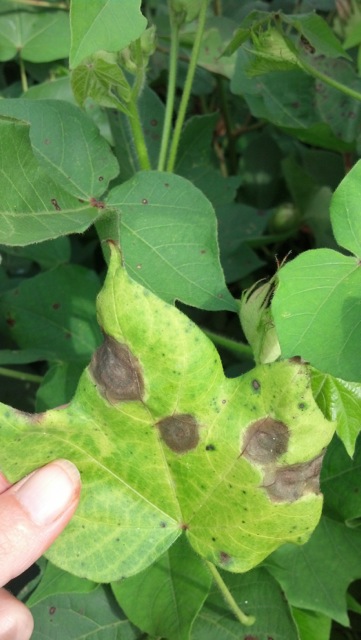
Target Spot Found on Cotton in Eastern NC
Written By Steve Koenning, Extension Plant Pathologist and Keith Edmisten, Cotton Extension Specialist, NCSU

Thursday, August 23, 2012
Plant Carbuncles: Anthracnose on Banana Peppers
 |
| Anthracnose on banana pepper (Photo: L. Kaderabek) |
 |
| Anthracnose lesions: Note salmon colored spores (Photo: L. Kaderabek) |
 |
| Anthracnose lesions: Note concentric rings and black fruiting bodies (Photo: L. Kaderabek) |
Anthracnose on pepper usually begins in “hotspots” in a field. The disease is favored by warm, wet weather. Because the masses of spores produced on the oozing lesions are perfectly adapted for dispersal in splashing rain or irrigation water, periods of rainy weather can lead to rapid spread and devastating losses.
The pathogen survives on plant debris left behind from previous plantings or on other susceptible plant hosts. Although the pathogen can survive on infested plant debris, typically it does not overwinter more than one year in the absence of a host, and rotation is an effective control. Peppers should be rotated out of infested fields or gardens for at least two years. Other hosts to avoid include tomatoes, eggplants, other solanaceous plants, and strawberries. The fungus can be introduced from contaminated seed, so always start with disease-free plants and seed. Removing infected fruit early in the season reduces inoculum levels. After harvest, disk or cultivate to bury debris. All infected fruit should be removed and buried. Left over plant debris from hotspots should also be removed to reduce inoculum levels.
 |
| Strawberry Anthracnose: Note salmon colored spores (Photo: E. Lookabaugh) |
 |
| Strawberry Anthracnose: Note red marbling of the crown (Photo: E. Lookabaugh) |
Wednesday, August 22, 2012
Mass Communicating Plant Pathology and Mycology: Part 2
Post submitted by Andrew Loyd, Graduate Research Assistant, North Carolina State University
 |
| Dr. Mike Benson discusses Plant Pathology on WKNC 88.1 FM July 21, 2012 |
The conversation was featured on Mystery Roach, a specialty show dedicated to psychedelic, progressive, noise, and garage rock from the 60′s and 70′s. The show airs, each and every Saturday from 8-10, often building around scientific conversations with an eclectic group of guests. The show is hosted by La Barba Rossa, aka Damian Maddalena. Damian is a forestry graduate student at NC State and has been the host of Mystery Roach for 4+ years.
On this rebroadcast, the music has been cut short for legality reasons, but if you enjoy this type of music the show can be streamed at www.wknc.org/listen every Saturday from 8-10AM EST.
Subscribe to:
Posts (Atom)